Georgia State University · Higher ed · Aug 2025 – Jun 2026
Finding the right AI learning tool for a university
Evaluating AI learning tools and shaping student and faculty research for a university-built learning assistant, as a UX research intern at GSU’s Center for Excellence in Teaching, Learning, and Online Education.
- Problem
- GSU wanted an AI learning assistant for students and faculty, but didn’t know whether an existing tool could meet their needs.
- My role
- UX research intern on a team of researchers and designers. I evaluated four AI learning tools, drafted student survey and interview questions, and reviewed the team’s faculty and student surveys.
- Methods
- Competitive analysis of 4 AI learning tools; survey and interview design for students and faculty in Qualtrics.
- Outcome
- No existing tool fit, so GSU moved to build its own, informed by this research.
Context
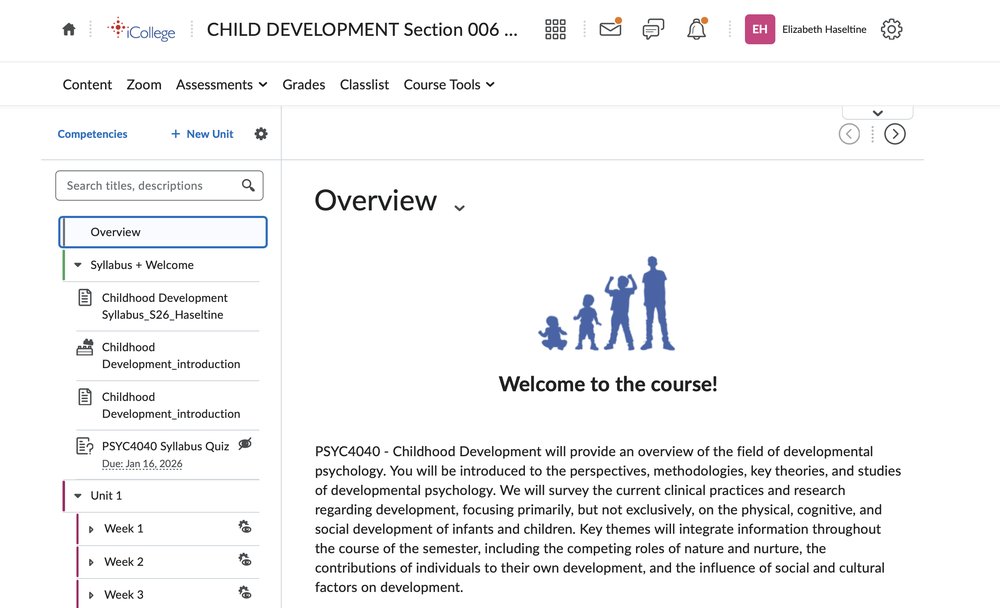
Georgia State wanted to give students and faculty an AI learning assistant connected to iCollege, the university’s learning platform. Before building anything, the team needed to know whether an existing AI learning tool could already meet their needs, and what students and faculty actually needed from one.
Approach
I evaluated four AI learning tools against the same six questions so they could be compared side by side. When none of the learning tools fit the needs of the university, the research turned generative: I drafted student survey and interview questions and reviewed the team’s student and faculty surveys.
Study plan
- Competitive analysisCogniti, LearnWise, D2L Lumi, U-M Maizey
Assessed each tool on who develops it, its features, the student experience, the instructor experience, how it connects to the learning platform, and how it builds its knowledge base.Why: compared tools on what would matter inside iCollege, not just on feature lists.
- Student survey and interview draftSurvey plus interview questions
Drafted questions on study strategies, help-seeking, current AI use and trust, and comfort with instructors seeing chatbot conversations.Why: understand how students already study and seek help before designing a tool to support them.
- Survey reviewFaculty and student surveys in Qualtrics
Reviewed both drafts for clarity, wording that could bias answers, length, and consistency between the two versions.
Findings
Every tool traded away something GSU needed.
| Cogniti | LearnWise | D2L Lumi | U-M Maizey | |
|---|---|---|---|---|
| Uses existing course content automatically | No | Yes | Yes | Yes |
| Instructor control over how the AI responds | High | Low | Low | High |
| Primary focus | Custom tutors | Campus and course support | Instructor workload | Course-specific help |
| Built for iCollege’s platform (Brightspace) | Standalone | Yes | Yes | No |
Summary of my evaluation of four AI learning tools, based on public documentation and demos.
- 1Automatic setup came at the cost of instructor control
LearnWise and Lumi drew from existing course content with no extra work, but gave instructors little say in how the AI interacted with students. Cogniti offered the most control, but instructors had to build each bot and upload materials themselves.
- 2Tools leaned toward either instructors or students
Lumi centered on reducing instructor workload, such as generating quizzes and refreshing content. LearnWise and Cogniti centered on supporting students. None balanced both.
- 3The closest fit wasn’t built for iCollege
Maizey combined automatic course syncing with instructor control and kept data contained, but it was built by the University of Michigan for Canvas. The tools built for iCollege’s platform offered less control.
Outcome
GSU is now building its own AI assistants for iCollege, and the research has shifted to faculty and student surveys about their needs and attitudes toward a new chatbot. I drafted the student survey and interview questions, which helped shape the final surveys in Qualtrics.
What I designed
- A survey built around how students already learn. Questions covered study strategies, help-seeking, and current AI use and trust, so a new tool could be designed to fit habits students already have.
- Parallel questions about instructors and AI. Students were asked when they seek help from instructors and when they turn to AI, so the two could be compared directly.
- A privacy comfort scale. Students rated how comfortable they would be with instructors seeing their full conversation, a summary of it, class-wide summaries, or how often they used the chatbot. This addressed one of the team’s open questions about how much instructors should be able to see.
- Follow-up questions for students whose first language isn’t English, to capture needs a general survey could miss.
- Interview questions that walk students through how they prepare for a big exam, starting from the moment they realize they need to study.
I also reviewed the team’s faculty and student surveys for clarity and wording that could bias answers, and kept the two consistent so responses could be compared for a fuller picture.
Reflection
What I took from it: Comparing the four tools showed that none met GSU’s needs, which gave the team a clear reason to step back and ask what students and faculty actually needed. It also made clear what a good tool would need to balance: easy setup, instructor control, and support for both students and faculty. Evaluating what already exists is often the best starting point for generative research, because the gaps show what to ask users next.